Visual Foxpro Driver 64 Bit
Posted on by admin
Visual Foxpro Driver 64 Bit Average ratng: 6,8/10 412 reviews
Active4 years ago
- Visual Foxpro Driver 64 Bit
- Visual Foxpro 9 Odbc Driver
- Microsoft Visual Foxpro Driver 64 Bit Download
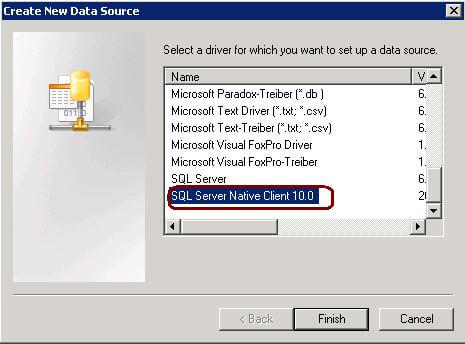
In order to load data from Visual FoxPro to 64-bit SQL Server, we can use Microsoft OLE DB Provider for Visual FoxPro or Visual FoxPro ODBC Driver to load data from Visual FoxPro, and then upload into SQL Server. Below are the detail steps for your reference. The Visual FoxPro OLE DB Provider (VfpOleDB.dll) exposes OLE DB interfaces that you can use to access Visual FoxPro databases and tables from other programming languages and applications. The Visual FoxPro OLE DB Provider is supported by OLE DB System Components as provided by MDAC 2.6 or later.
We're trying to access Foxpro file-based database files via MSSQL Server's linked server feature, using Foxpro ODBC driver.
For this, we've
- installed the latest Foxpro ODBC Driver from Microsoft,
- made a System DSN which is using this driver
- chose the 'Visual FoxPro database (.DBC)' option under Database type, instead of 'Free table directory'
- specified the path to our dbc file (on local machine)
- installed MSSQL Server 2008 R2 Express
- installed MSSQL Server Management Studio 2008
- tried to create a new linked server by using a GUI wizard like this:
But the last step never completes (Executing is displayed forever).When Management Studio is forcibly closed and restarted the new linked server is there but only contains Catalogues subitem. If we try to expand it, Management Studio goes into loop yet again.
HennoHenno6225 gold badges15 silver badges31 bronze badges
2 Answers
- Download and install Microsoft OLE DB Provider for Visual FoxPro
- Make sure it appears in MSSQL Management Studio, under System Objects > Linked Servers > Providers, as 'VFPOLEDB'. I had to install it, uninstall it and re-install it until I got it there (and no, restarting Windows did not work).
- Open System Objects, right click Linked Servers and choose to add a new linked server.
- Fill the form as like this:
- No need to add any DSNs in ODBC applet
- Click OK and see if you can now drill down the new linked server until you see the tables.
- Right click on some table and script a SELECT query to new query window. This gives you an example how to query this new linked server:
SELECT * FROM [myLinkedServer]...[myTable]
6225 gold badges15 silver badges31 bronze badges
The first thing to do is to make sure that you are using 32 bit drivers if you have a 32 bit SQL Server and 64 bit drivers if you are using a 64 bit SQL Server. 64 bit SQL Servers can't use 32 bit ODBC (or OLEDB or anything else) drivers.
I have had the old ODBC drivers from Microsoft bring down server instances, so i avoid them.
On recent versions of SQL Server, 2005+, I've had the best success with the 'ACE' drivers. These drivers replace the old 'JET' drivers and were introduced with Office 2007. They are OLEDB based, but you wouldn't necessarily notice. The release for Office 2010 that comes in 32 bit and 64 bit versions. The redistributable ACE drivers are available for download on Microsoft's site.
With the new drivers, you don't need to create a system DSN like with the old ODBC drivers. You can just create the linked server and go. There should be plenty of examples of how to create linked servers using ACE drivers (both with TSQL and the SSMS GUI) on the internet.
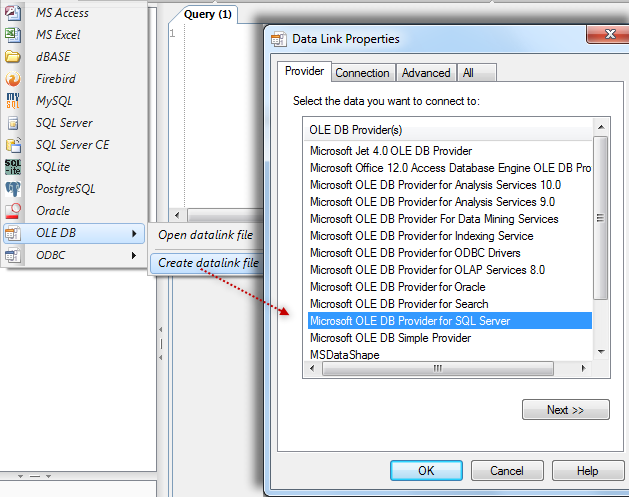
You will want to be sure that the provider representing your drivers (look under the Linked servers folder for the Providers folder) is set to 'Allow in process' and .
You may also find that accessing files on the network is harder than accessing the same file on a local disk. This is usually a problem with delegation and security. Getting that going can be a hassle, depending on your infrastructure.

(If you are interested, I did a few of blog entries 'Legacy Connectivity in a 64 bit world' about three or four years ago, covering dbase/foxpro issues, 32/64 bit issues, plus db/2 and other stuff. There is probably more than there than you would want to read. This was back before the 64 bit ACE drivers were released, and things are better now.)
darin straitdarin strait
Visual Foxpro Driver 64 Bit
protected by Michael Hampton♦Aug 11 '15 at 16:53
Thank you for your interest in this question. Because it has attracted low-quality or spam answers that had to be removed, posting an answer now requires 10 reputation on this site (the association bonus does not count).
Would you like to answer one of these unanswered questions instead?
Not the answer you're looking for? Browse other questions tagged sql-serverlinked-servererp or ask your own question.
-->Microsoft Visual FoxPro is a powerful object-oriented environment for database construction and application development. The Microsoft Visual FoxPro ODBC Driver enables applications to open, query, and update data in Visual FoxPro and earlier versions of FoxPro through the Open Database Connectivity (ODBC) interface.
For example, with the Microsoft Visual FoxPro ODBC Driver you can do the following:
Use Microsoft Query to query and update Visual FoxPro data from Microsoft Excel worksheets.
Create mail-merge letters using Visual FoxPro data with Microsoft Word.
Query and update Visual FoxPro views and tables from Microsoft Access.
Use Visual FoxPro as the data store for Microsoft Visual Basic, Microsoft Visual C++, and C applications.
Visual Foxpro 9 Odbc Driver
You can use the driver to accomplish many other tasks. The following table lists a few topics to help you get started.
Microsoft Visual Foxpro Driver 64 Bit Download
| To | See |
|---|---|
| Find out more about using Visual FoxPro data with Microsoft Office | Accessing Visual FoxPro Data from Microsoft Office |
| Learn about using Visual FoxPro data in Visual Basic applications | Using the Visual FoxPro ODBC Driver with Your Visual Basic Application |
| View a simple example using Visual C++ to access Visual FoxPro data | Using the Visual FoxPro ODBC Driver with Your C or C++ Application |
| See a list of supported hardware and software | System Requirements |
For information about downloading and installing the Visual FoxPro ODBC driver, see Visual FoxPro ODBC Driver on MSDN Downloads.